The Ultimate Guide to the Imperial Festival of the Sun & Machu Picchu Combo
History, Inca ceremonies, official performances, ticket categories, seating zones, prices, reservations, travel planning, cultural traditions, and practical advice for international visitors.
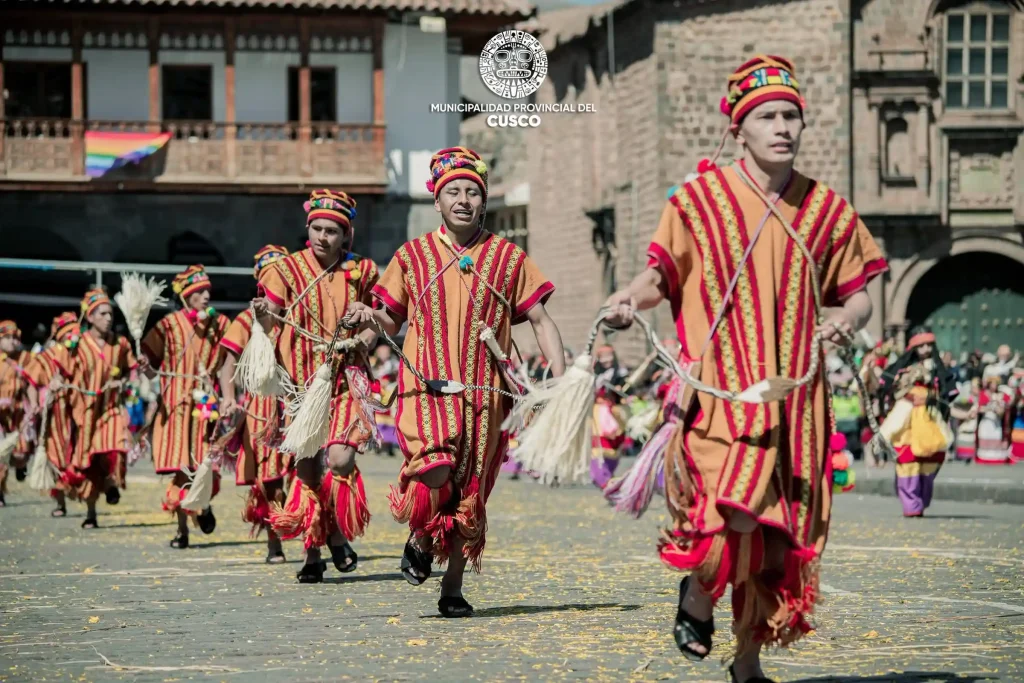
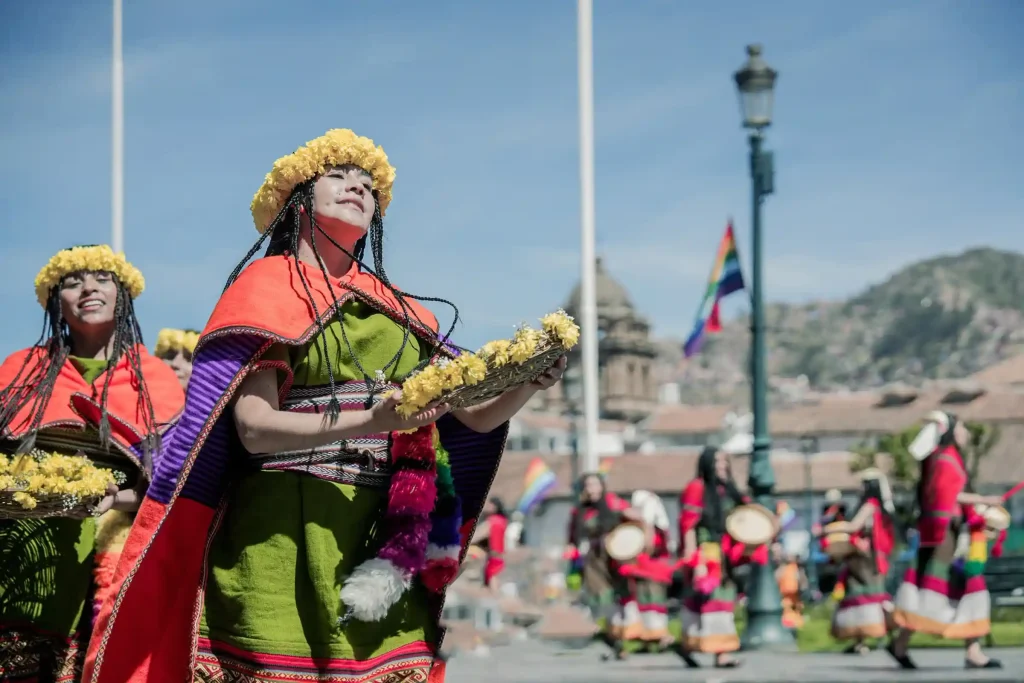
Every June, the ancient capital of the Inca Empire becomes the setting for one of South America’s most extraordinary cultural celebrations. Hundreds of performers dressed in elaborate ceremonial costumes recreate the rituals of an imperial civilization, while traditional Andean music echoes through the streets of Cusco and the monumental stone walls of Saqsaywaman.
At the center stands the Sapa Inca, supreme ruler of the Inca Empire, symbolically leading his people in honoring Inti, the Sun God. Inti Raymi—the Festival of the Sun—combines pre-Hispanic history, Quechua language, Andean spirituality, theater, music, and cultural identity.
| Celebration Date | Thursday, June 24, 2027 |
|---|---|
| Destination | Cusco, Peru (High Andes) |
| Historical Origin | Inca Empire; associated with Pachacuti |
| Quechua Meaning | Inti (Sun) + Raymi (Celebration) |
| Principal Deity | Inti, the Sacred Sun God |
| Main Organizer | EMUFEC (Municipal Festivities of Cusco) |
| Main Locations | Qorikancha, Plaza de Armas, Saqsaywaman |
| Ceremonial Tongue | Runasimi (Quechua) |
| Modern Revival | June 24, 1944 (83rd Anniversary) |
| Performers | Over 800 actors, dancers and musicians |
| Main Performance | Saqsaywaman (Chukipampa Esplanade) |
| Cusco Elevation | 3,400 m / 11,155 ft |
| Saqsaywaman Elev. | 3,700 m / 12,140 ft |
| Recommended Stay | 3 to 5 nights minimum for acclimatization |
The latest verified official prices and detailed terms referenced in this guide reflect the official 2026 edition organized by EMUFEC. Commercially advertised 2027 packages should not be mistaken for an official 2027 ticket release. Authentic operators secure provisional reservations and confirm seat allocations once EMUFEC opens the official ticketing window.
Welcome to Cusco! Inti Raymi is not just a theatrical event—it is the living heartbeat of our Inca heritage. Every June, we walk alongside our ancestors. When you book with Andean Peru Treks, you aren't buying a generic ticket through an intermediary. We are born and raised in Cusco, licensed by DIRCETUR and SERNANP, and personally coordinate every step of your journey—from securing your front-row VIP grandstand seats in Saqsaywaman to preparing hot coca tea and managing altitude acclimation. Watch our welcome video to see how we transform your journey into an authentic, life-changing immersion.
Inti Raymi comes from the Quechua words Inti (Sun) and Raymi (festival or celebration). In Tawantinsuyu, the Sun held religious, agricultural, and political significance. Sunlight supported maize, potatoes, quinoa, and agricultural production throughout the Andes. Seasonal observation helped communities organize agricultural work and ceremonies.
The ruling Inca dynasty claimed a privileged relationship with Inti, supporting the Sapa Inca’s religious and political authority. The historic celebration honored the Sun, recognized the renewal of seasonal cycles, reinforced imperial unity, and brought together representatives of different territories.
The festival is associated with the southern winter solstice, when daylight hours are shortest. However, the modern performance is fixed on June 24, a few days after the astronomical solstice, usually June 20 or 21.
Traditionally associated with Pachacuti. Ceremonial gatherings of nobles, priests, fasting, sacred music, and offerings over multiple days. Historical celebrations spanned across imperial Cusco.
Following Spanish conquest, colonial Viceroyalty prohibited open Inca rituals. Beliefs persisted privately through syncretism and agricultural customs across Andean communities.
Spearheaded by Humberto Vidal Unda and Faustino Espinoza Navarro based on Garcilaso de la Vega's chronicles. Declared Cultural Heritage of the Nation by Peru in 2001.
| Period | Historical Significance & Milestone |
|---|---|
| 15th century | Festival instituted under Pachacuti as the premier Inca imperial state celebration |
| 16th century | Colonial Viceroyalty ban on Indigenous public sun worship ceremonies |
| 1944 | Modern cultural reenactment launched in Cusco based on Garcilaso de la Vega's chronicles |
| 2001 | Officially recognized by the Peruvian government as Cultural Heritage of the Nation |
| 2026 | Introduction of modern ticket seating zones: Illapa, Chaska, Killa VIP, and Inti Super VIP |
| June 24, 2027 | 83rd Modern Anniversary Grand Celebration in Cusco & Saqsaywaman |
Today’s Inti Raymi is a historically inspired theatrical reconstruction rather than an exact replication of a ceremony continuously performed since the 15th century. Its script, choreography, clothing, and production have been adapted for contemporary audiences. Nevertheless, it incorporates historical research, Quechua ceremonial language, Andean artistic forms, and cultural memory. The modern celebration has cultural significance in its own right as an expression of Cusco’s identity.
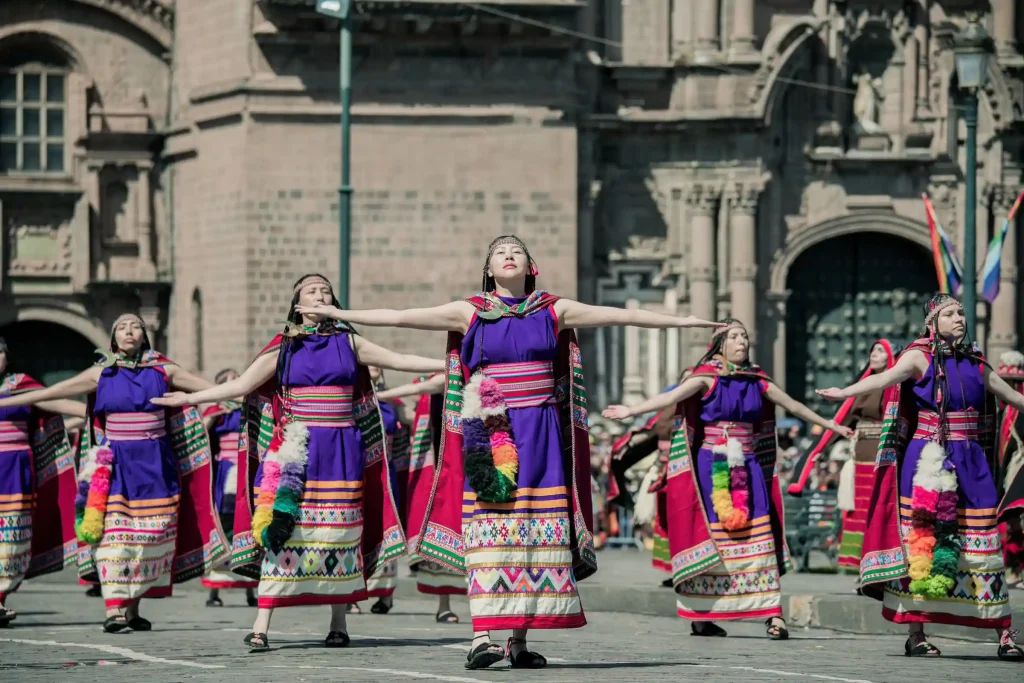
Against the colossal stone bastions of Saqsaywaman, over 800 ceremonial actors, imperial guards, and sacred priests gather to honor the eternal Sun God.
Reserve Your Official SeatThe festival takes place across three historic settings in Cusco. Each venue corresponds to a distinct phase of the ceremonial progression, starting at the Temple of the Sun in the city center and culminating at the monumental fortress esplanade of Saqsaywaman.
| Stage | Location | Typical Time | Viewing Access | Ceremonial Focus |
|---|---|---|---|---|
| 1 | Qorikancha | Around 9:00 AM | Designated free areas & paid grandstand | Greeting to the Sun (Opening ceremony) |
| 2 | Plaza de Armas | Around 10:00–11:00 AM | Open public viewing areas | Encounter of the Two Worlds, rite of coca & khipu |
| 3 | Saqsaywaman | Roughly 1:00–4:30 PM | Official paid grandstand seating | Main imperial ceremony, llama sacrifice rite, four suyus |
Qorikancha, the Golden Enclosure, was one of the Inca capital’s most important sacred sites. The modern ceremony begins with the appearance of the Sapa Inca, entourage, musicians, and ceremonial figures. It invokes the Sun and establishes the day’s spiritual themes. The historic Inca walls and later Church and Convent of Santo Domingo make the setting architecturally remarkable. Approximate performance duration: 30–60 minutes. Public viewing is possible where authorized, but visibility and capacity are limited.
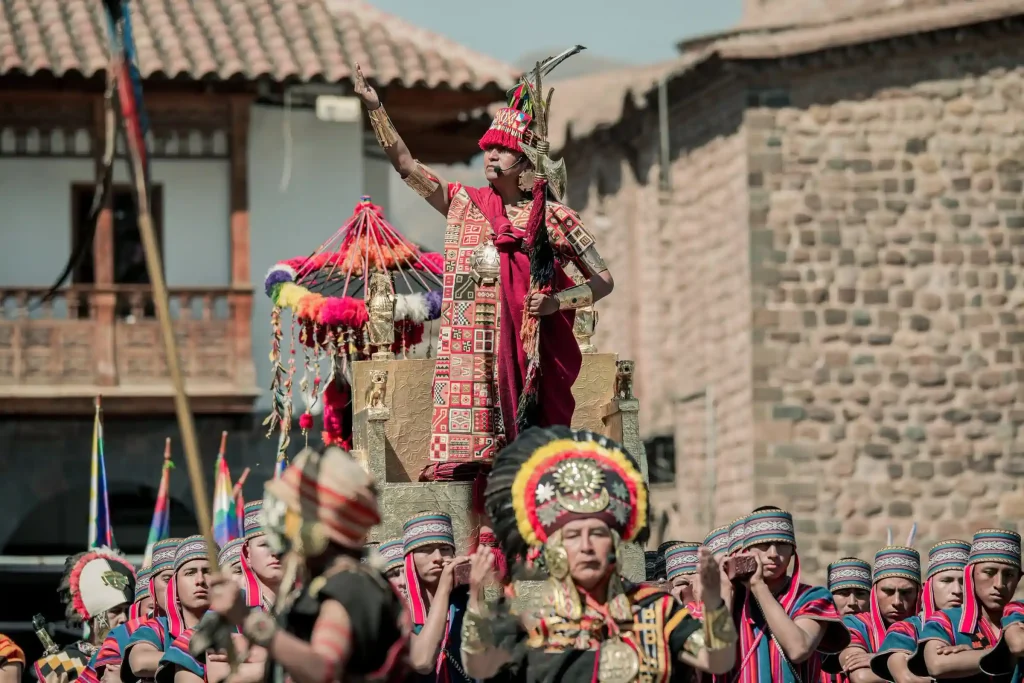
Crowds gather across Avenida El Sol, Pampa del Castillo, and surrounding balconies. Police and municipal guards establish secure ceremonial perimeters around the Santo Domingo garden terraces.
Imperial horn blowers sound the ancestral pututus from the ancient curved stone walls of Qorikancha. The deep sonic resonance silences the gathering and announces the arrival of the imperial court.
The Sinchi (Supreme Military General) and royal lance-bearers enter the esplanade, performing ritual perimeter checks to ensure the sacred ground is purified for the Son of the Sun.
Accompanied by royal attendants and music, the Sapa Inca and Empress Qoya emerge atop the ceremonial platform in radiant gold regalia, carrying the sun scepter (Mascapaicha).
The Sapa Inca delivers a powerfulQuechua hymn honoring Inti, giving thanks for the harvest of corn, potatoes, and quinoa, and pleading for winter warmth across Tawantinsuyu.
The Sun maidens scatter sacred yellow cantuta flowers and coca leaves along the royal pathway as the entire royal court begins the majestic march toward the Plaza de Armas.
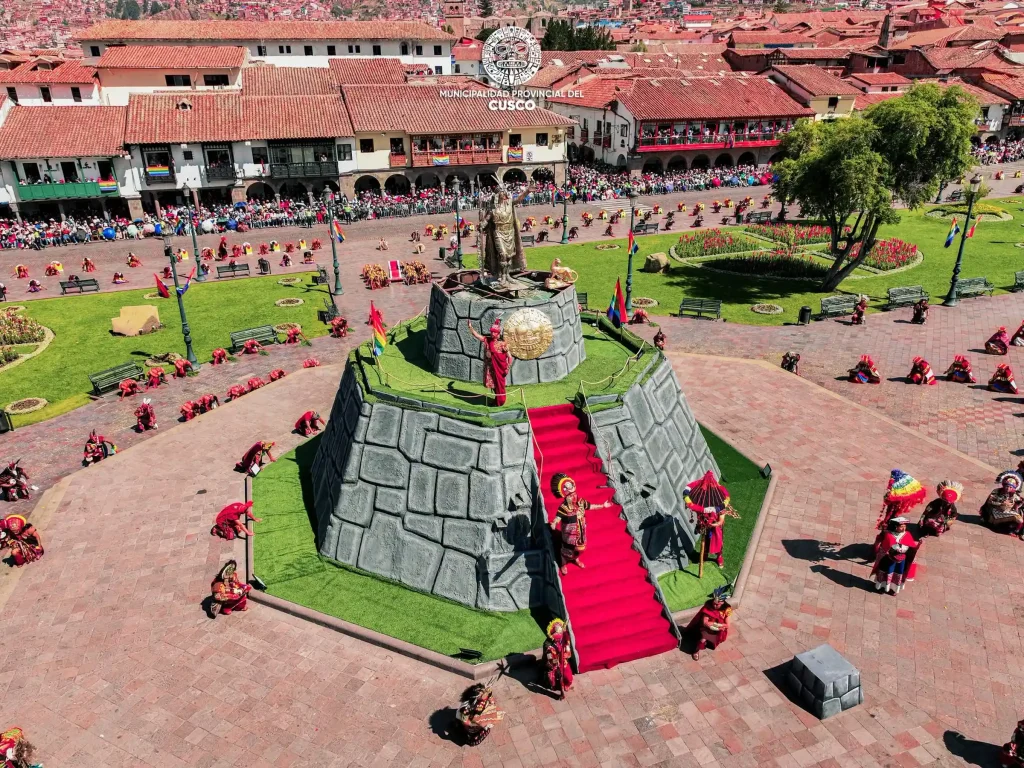
The imperial procession reaches the former Hawqaypata. The performance includes the rite of coca and a symbolic encounter between the historical Inca ruler and contemporary civic authority. A khipu symbolizes cultural continuity and values often expressed as Munay (love or will), Yachay (knowledge), and Llank’ay (work). The historic square, ceremonial costumes, musicians, and balconies create a powerful visual setting. Approximate presentation: 45–60 minutes, excluding procession time.
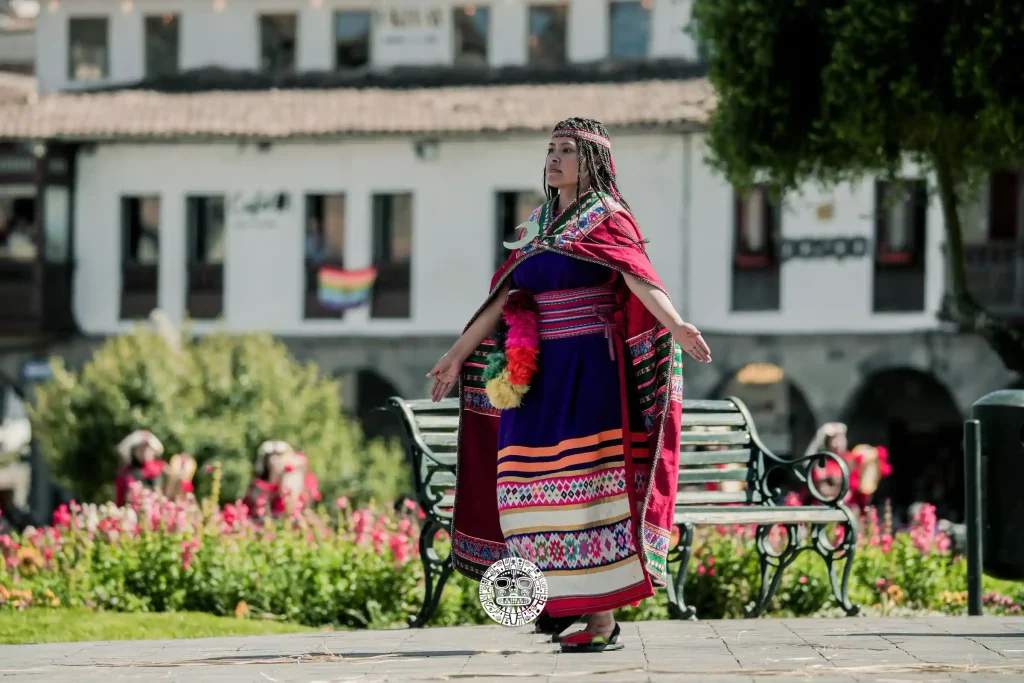
Tens of thousands of locals and travelers fill the arcades, balconies, and sidewalks of the Plaza de Armas. Brass bands and traditional pututeros announce the procession's advance.
Warriors and musicians representing the Four Suyus sweep into the Plaza from ancient stone passageways, performing acrobatic dances and forming a grand protective circle around the central fountain.
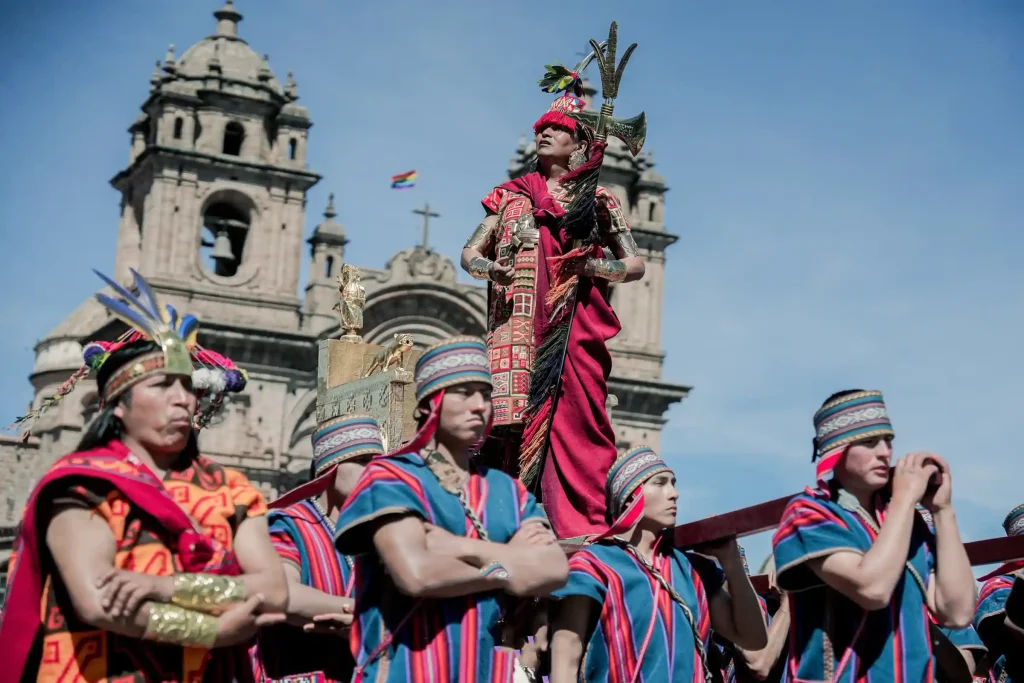
Carried upon the shoulders of forty imperial retainers, the Sapa Inca's litter enters the center of the square to thunderous cheering, surrounded by waving rainbow Wiphala flags.
The historical Inca ruler meets face-to-face with the Mayor of Cusco. The Inca delivers the ceremonial Khipu and challenges the civic leader to rule with righteousness and integrity.
The Willaq Umu (High Priest) throws sacred coca leaves onto an altar cloth to divine the future prosperity, weather patterns, and social unity of the Andean lands.
The Sapa Inca addresses the multitude with a message of pride and brotherhood before directing the court to ascend through Calle Resbalosa and San Cristóbal towards Saqsaywaman.
The principal performance unfolds on the Chukipampa esplanade, against Saqsaywaman’s monumental stone architecture. A large cast represents the four regions of Tawantinsuyu, the imperial court, priests, attendants, dancers, and musicians. The Sapa Inca presides over reports, invocations, offerings, chicha, sacred fire, a simulated llama sacrifice, and the ceremonial sharing of food. The main performance lasts approximately three hours. Visitors traveling specifically for Inti Raymi will generally want to prioritize this venue.
Spectators access the archaeological perimeter via authorized tour shuttles or guided ascent. Guests locate their assigned seats in Illapa, Chaska, or Killa VIP bleachers and receive their gourmet Andean box lunches.
Security gates close strictly per EMUFEC regulations. Conch horns sound from the top of Suchuna hill as musicians take their designated positions around the esplanade.
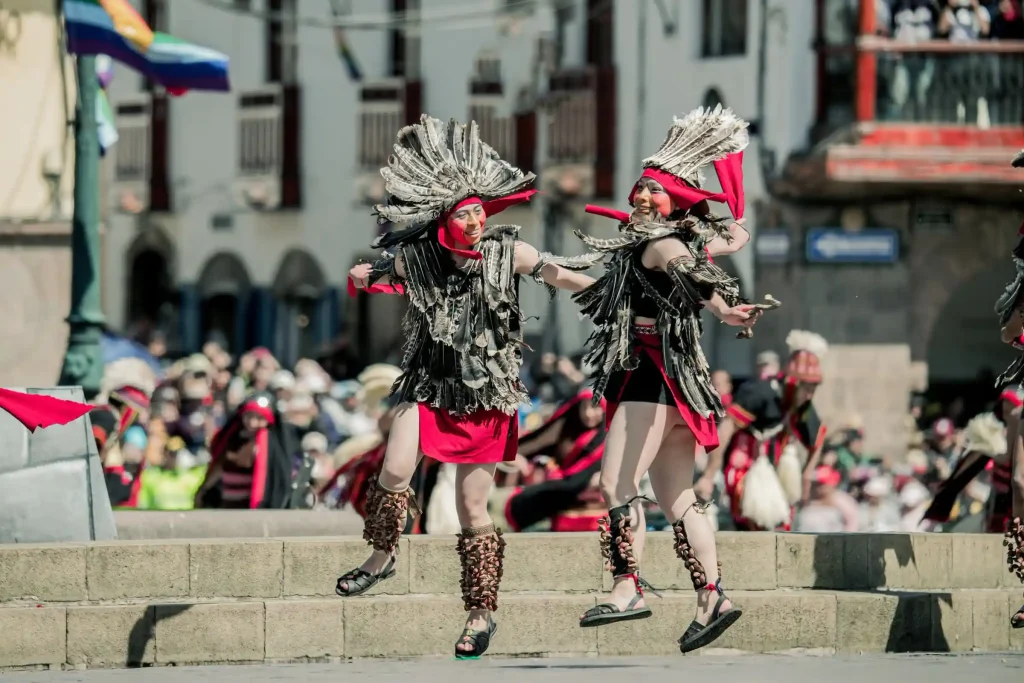
Over 800 costumed performers enter in breathtaking succession: the coastal Chinchaysuyu, jungle Antisuyu, southern Qollasuyu, and western Cuntisuyu, showcasing region-specific weaponry, feathers, and traditional textiles.
Carried upon the ceremonial golden litter, the Sapa Inca mounts the central Usnu pyramid, flanked by the Willaq Umu (High Priest) and royal acllas, to take command of the ritual proceedings.
The Inca pours fermented corn beer (chicha) from a golden vessel (Aqilla) into a stone channel feeding Pachamama, drinking with Father Sun as an eternal covenant of gratitude.
Using a concave golden mirror to concentrate the solar rays onto dried cotton, priests kindle the New Sacred Fire. Embers are distributed to virgin runners to rekindle the hearths of the empire.
A symbolic theatrical sacrifice of a black llama is enacted. The high priest reads the simulated entrails and heart to divine climatic fertility, harvests, and peace for the upcoming agricultural year.
The Sapa Inca blesses the Sankhu, ceremonial corn bread kneaded with sacred water and chicha. Portions are distributed among the nobles and representatives of the Four Suyus to seal imperial brotherhood.
All 800+ dancers, warriors, priests, and court attendants erupt into a thunderous collective dance of victory and joy, circling the esplanade as music reaches an exhilarating crescendo.
The Sapa Inca is carried out under the late afternoon golden light. Guided tour groups transition to designated private shuttle transfer zones or enjoy a leisurely sunset stroll down to Cusco.
Logistical Tip: The walking ascent from Plaza de Armas to Chukipampa gates takes approximately 30–60 minutes at 3,700 m elevation. Vehicle routes are strictly restricted on June 24.
The main ceremony at Saqsaywaman follows a detailed theatrical narrative divided into eleven ceremonial acts:
From central Peru through Ecuador into southern Colombia.
The eastern Andes, sacred valleys, and Amazonian cloud forests.
High plateau of Lake Titicaca, Bolivia, Chile, and NW Argentina.
Southwestern coastal and Andean corridors to the Pacific Ocean.
Official cultural production showcasing the majestic imperial reenactment at Saqsaywaman Fortress.
Follow official admission and gate closure instructions, which precede show start times. Plan your morning comfortably to arrive on time at Saqsaywaman.
| Time | Suggested Plan & Milestones |
|---|---|
| 6:30–7:30 AM | Hearty breakfast, hydration, and packing daypack with sunscreen, layers, and printed tickets |
| 7:30–8:30 AM | Arrive at designated tour meeting point or central Qorikancha observation perimeter |
| Around 9:00 AM | Opening Ceremony begins at the Temple of the Sun (Qorikancha) |
| 10:00–11:30 AM | Procession winds through historic lanes to Hawqaypata (Plaza de Armas) |
| 11:30 AM–12:30 PM | Proceed toward Saqsaywaman fortress subject to event traffic checkpoints |
| Noon–1:00 PM | Official security inspection, ticket scanning, and grandstand seating |
| 1:00–1:30 PM | Main Imperial Ceremony Begins at Chukipampa Esplanade |
| 4:00–5:00 PM | Grand Ceremony concludes; closing celebratory dances of the four suyus |
| 5:00–6:30 PM | Controlled pedestrian and vehicle exit; return to Cusco historic center |
Older articles describe green, red, and orange seating. The official 2026 listing instead used Illapa, Chaska, Killa VIP, and Inti Super VIP. Do not assume direct equivalence between old and new labels.
Lowest-priced official category. Excellent for budget-conscious travelers seeking confirmed access to the main spectacle without paying top-tier premiums.
Higher-tier general category offering strong sightlines and elevated bleacher positioning overlooking the central altar.
Official VIP grandstand offering elevated frontal perspective. Preferred by cultural travelers desiring superior stage orientation.
Top-tier official category positioned directly opposite the Sapa Inca's throne for supreme proximity and ceremonial prominence.
| Location / Category | General Admission | Children (5–12) | Eligible Guides |
|---|---|---|---|
| Saqsaywaman – Illapa | S/ 490 | S/ 250 | S/ 250 |
| Saqsaywaman – Chaska | S/ 680 | S/ 340 | S/ 340 |
| Saqsaywaman – Killa VIP | S/ 730 | S/ 365 | S/ 365 |
| Saqsaywaman – Inti Super VIP | S/ 850 | S/ 430 | S/ 430 |
| Qorikancha Seating | S/ 235 | S/ 120 | S/ 120 |
| Combined Package | Official Price (S/) |
|---|---|
| Qorikancha + Illapa | S/ 690 |
| Qorikancha + Chaska | S/ 870 |
| Qorikancha + Killa VIP | S/ 920 |
| Qorikancha + Inti Super VIP | S/ 1,030 |
*Note: Verified official prices from the 2026 edition provided as a baseline planning reference. 2027 rates await official confirmation by EMUFEC. Transportation and guide services are coordinated by tour operators.
Free public observation is traditionally possible at designated Qorikancha and Plaza de Armas areas. However, capacity, barriers, and crowds can severely limit visibility. Some private balconies charge for access independently of official admission.
Distant public observation around Saqsaywaman may be possible only where authorities permit; it is not guaranteed, and it does not include an official seat. Visitors should not enter restricted archaeological terrain or rely on informal hillside access. For travelers whose main objective is the full main ceremony, authorized paid seating provides greater certainty.
Required information: full legal name, passport/ID number, nationality, date of birth for minors, contact email.
Late 2026 / Early 2027: Agencies accept provisional pre-reservations and plan itineraries.
March to May 2027: EMUFEC typically opens official online ticket sales through Teleticket.
May to June 2027: Best seats sell out; hotel and train capacity becomes scarce.
Pair the theatrical splendour of imperial Cusco with the timeless stone sanctuary of the Incas. June offers Peru's premier dry season weather for hiking and citadel exploring.
Book the 6-Day ComboMachu Picchu offers insight into Inca architecture and landscape planning; Inti Raymi interprets the empire’s ceremonial and political world. They make a compelling combined itinerary, but each requires separate reservations. An Inti Raymi ticket does not include Machu Picchu admission. Machu Picchu admissions depend on specific dates, circuits, routes, and entry times under the relevant official rules.
Ideal for travelers on tight vacation schedules prioritizing the festival on June 24.
Arrive in Cusco (morning), check into hotel, rest and begin gentle altitude acclimatization.
Light historic center walking tour, briefing with tour guide, and festival preparations.
Full-day celebration at Qorikancha, Plaza de Armas, and VIP Saqsaywaman grandstand.
The premier itinerary combining altitude acclimatization, Sacred Valley, Inti Raymi VIP, and the Classic Machu Picchu Citadel.
Airport reception, transfer to hotel, coca tea welcome, gentle acclimatization rest.
Visit Qorikancha, Saqsaywaman, Qenqo, Puka Pukara, and Tambomachay.
Pisac ruins and artisan market, buffet lunch in Urubamba, Ollantaytambo Fortress.
VIP seating at Saqsaywaman, bilingual historian guide, private transport, gourmet box lunch.
Vistadome scenic train through the Urubamba canyon to Machu Picchu Pueblo, hotel check-in.
Guided visit of the Classic Circuit, iconic viewpoints, scenic return train to Cusco.
Complete southern Peru immersion including Maras Salt Mines, Moray, Inti Raymi, and Machu Picchu with optional Huayna Picchu hike.
Arrival, Cusco archaeological sites & Sacred Valley immersion.
Inti Raymi VIP at Qorikancha and Saqsaywaman.
Maras Salt Mines & Moray agricultural terraces.
Machu Picchu sunrise guided tour & flight departure.
June coincides with the Southern Hemisphere's winter solstice and Cusco's classic dry season. Days feature crisp, cloudless blue skies and intense direct sunlight, but the combination of high elevation (3,400 m to 3,700 m) and dry mountain air produces dramatic temperature fluctuations within a single 24-hour cycle.
| Meteorological Factor | Daytime (10 AM – 3 PM) | Late Afternoon (After 4 PM) | Night & Dawn (7 PM – 6 AM) |
|---|---|---|---|
| Air Temperature | 18°C to 22°C (64°F to 72°F) | 10°C to 14°C (50°F to 57°F) | 0°C to 4°C (32°F to 39°F) |
| Solar UV Index | Extreme: Index 12 to 14+ | Moderate (Index 3–5) | Zero |
| Relative Humidity | 20% – 30% (Very Dry) | 35% – 45% | 40% – 50% |
| Wind Conditions | Light thermal breeze | Gusty mountain windchill at Saqsaywaman | Calm, frosty |
Because the atmosphere is roughly 35% thinner at 3,700 meters than at sea level, it filters significantly less solar radiation. Unprotected skin can develop severe sunburn within 15 minutes of direct midday exposure. Broad-spectrum SPF 50+ sunscreen, UV-blocking sunglasses, and wide-brim hats are medical necessities.
As the sun sinks behind the peaks around 4:15 PM, the temperature on the exposed Chukipampa esplanade drops by 10°C (18°F) within 30 minutes. Always pack a compact fleece and windbreaker inside your daypack, even if departing your hotel under warm morning sunshine.
Arriving two or three days before the event is a sensible minimum for many travelers coming directly from low elevations, though some need longer. During initial acclimatization, avoid strenuous exertion and ascend gradually. Headache, nausea, poor sleep, or fatigue can occur with altitude exposure. Severe headache, repeated vomiting, breathing difficulty at rest, confusion, or inability to walk normally require prompt medical evaluation. Visitors with relevant cardiovascular, respiratory, or prior serious altitude conditions should consult a qualified clinician beforehand.
| Destination / Landmark | Elevation (Meters) | Elevation (Feet) | Strategic Acclimatization Advice |
|---|---|---|---|
| Lima (Jorge Chávez Airport) | 34 m | 111 ft | Sea level gateway; sleep well before flying to Andes. |
| Machu Picchu Sanctuary | 2,430 m | 7,972 ft | Lush subtropical valley; rarely causes altitude sickness. |
| Ollantaytambo (Sacred Valley) | 2,790 m | 9,154 ft | Recommended first stop: Sleep here nights 1–2 to adapt gently. |
| Cusco Historic Center | 3,400 m | 11,155 ft | Arrive at least 48 to 72 hours before June 24. Limit heavy walking. |
| Saqsaywaman Chuquipampa | 3,700 m | 12,140 ft | Highest festival venue. Sitting in bleachers requires slow, deep breathing. |
Drink 3 to 4 liters of clean water and electrolyte fluids daily. Traditional coca leaf tea (mate de coca) in the morning dilates capillaries and aids oxygenation; switch to muña (Andean wild mint) in the late afternoon to support digestion and avoid caffeine insomnia.
Consult your travel clinic or physician before departing regarding Acetazolamide (Diamox). If prescribed, taking 125 mg to 250 mg twice daily beginning 24 hours prior to Cusco arrival can speed metabolic adaptation. Avoid sleeping pills and heavy alcohol for your first 48 hours.
Mild headaches and shortness of breath upon stairs are normal. However, severe throbbing headaches unresponsive to hydration, confusion, persistent vomiting, or blue lips require immediate medical assessment and oxygen administration. Our guides carry pulse oximeters and portable oxygen.
Spectators spend approximately 6 to 8 hours outdoors across varying venues on June 24. Because bleacher storage is limited and reentry is prohibited, pack smart and light using a compact daypack under 20 liters.
Mandatory at all official Saqsaywaman gates. Digital photos on phones are not accepted by EMUFEC police cordons without the original document.
Reapply every 90 minutes. High altitude dry wind chaps lips rapidly; use a zinc or beeswax balm with UV filter.
Grandstands have zero roof shade. A full-brim hat protects ears and neck. Polarized lenses eliminate harsh mountain glare.
Wear a breathable base shirt for the 22°C midday sun, but keep a compact packable down jacket or fleece ready for the 4:00 PM chill.
Avoid open sandals. Ancient Inca stone ramps, uneven cobblestones, and dirt trails around Chukipampa require sturdy shoes with grip.
Cold temperatures and constant photo/video recording drain smartphone and camera batteries at twice their normal rate.
Glass containers are strictly confiscated by security. Bring an aluminum or insulated bottle with electrolytes.
Credit cards cannot be used on the mountain. Small bills and coins are essential for restroom access fees (S/ 2) and artisanal crafts.
Temporary event restrooms behind the grandstands routinely run out of paper during peak afternoon hours. Be self-sufficient.
Spectators in grandstands are roughly 30–80 meters from the central Usnu. A 70–200mm lens captures stunning facial expressions of the Sapa Inca.
The historic center is often the most convenient choice for first-time festival visitors. Request a quiet room if sensitive to nighttime celebrations. Book hotels well ahead of June and review cancellation terms.
| Neighborhood / Area | Key Advantages | Practical Considerations | Suitability |
|---|---|---|---|
| Historic Center (Plaza de Armas / Santa Catalina) | Walking distance (2–5 mins) to Qorikancha and Plaza de Armas stages. Vibrant energy and colonial architecture. | Streets closed to vehicular traffic on June 24; late-night marching bands and fireworks can disturb light sleepers. | Best for First-Timers |
| San Blas (Artisan Quarter) | Charming cobblestone pedestrian alleys, boutique hotels, artisan workshops, and quiet courtyard dining. | Steep pedestrian stairs with no vehicular access; difficult for travelers carrying heavy bags or struggling with altitude. | Best for Couples & Arts |
| San Cristóbal / Santa Ana | Perched on the northern hillside; offers spectacular panoramic views over Cusco and is geographically closer to Saqsaywaman. | Steep 15-minute uphill walk from the central plaza; requires solid physical fitness or taxi rides before street closures. | Scenic & Hillside |
| Lucrepata / Magisterio | Modern residential sectors with quiet luxury hotels, flat terrain, and uninterrupted vehicle access outside the police cordon. | Requires a 10-minute taxi ride to reach the historic core; detached from the central celebratory street atmosphere. | Quiet & Modern |
| Sacred Valley (Urubamba / Ollantaytambo) | Lower elevation (2,790 m to 2,870 m); ideal for gentle acclimatization, luxury resort spas, and peaceful gardens. | Located 1.5 to 2 hours drive from Cusco; requires a 5:30 AM departure on June 24 to reach Cusco before festival traffic locks. | Acclimatization Base |
Expert Recommendation: Split your stay: Spend your first 2 nights relaxing in the Sacred Valley (Urubamba) to adapt to the altitude, then transfer to a central Cusco hotel on June 23 so you can walk directly to Qorikancha on festival morning.
Inti Raymi on June 24 is the grand climax of El Mes Jubilar del Cusco (Cusco's Jubilee Month). Throughout June, the city transforms into an open-air cultural theater with non-stop celebrations that allow visitors to experience living Andean folklore.
One of Latin America's most elaborate religious festivals. Fifteen patron saints and virgins from neighborhood parishes are carried on multi-ton silver litters to the Cathedral of Cusco, accompanied by brass bands and native dancers.
The traditional feast eaten during Corpus Christi, featuring roasted guinea pig (cuy), boiled chicken, dried jerky (ch'arki), corn cakes, toasted Andean corn, cheese, and seaweed.
Between June 10 and June 23, universities, secondary schools, cultural institutes, and traditional brotherhoods fill the Plaza de Armas from 9:00 AM to 10:00 PM daily. Over 50,000 costumed dancers perform traditional dances such as Qhapaq Qolla, Saqra, Huaylash, and Contradanza in radiant hand-woven garments.
A massive civic celebration in the Plaza de Armas featuring synchronized fireworks displays illuminated against the cathedral towers, live Andean folk bands, and international concerts that unite the entire city on the eve of the Sun Festival.
While Cusco honors Inti, the nearby Amazonian and subtropical regions celebrate the Feast of Saint John the Baptist with the preparation of traditional Juane (rice, chicken, and egg parcels wrapped in bijao leaves) and river purification rituals.
EMUFEC installs batteries of portable chemical toilets in the open field directly behind the grandstand bleachers. Because thousands of ticket holders share these facilities, queues can exceed 15–20 minutes immediately before the 1:00 PM ceremony and after the final dance.
Tip: Use hotel facilities prior to departure, visit the portable restrooms upon arrival before gates lock at 1:00 PM, and always carry pocket tissues and hand sanitizer.
The ceremony takes place through standard lunchtime (1:00 PM to 4:30 PM). There are no sit-down restaurants inside the archaeological park. Outside the gates, local vendors sell traditional street snacks, but food hygiene varies greatly.
All Andean Peru Treks packages provide a certified gourmet box lunch prepared by sanitized tourist kitchens, including whole grains, fresh fruit, protein, and bottled water.
Starting at 5:00 AM on June 24, Cusco police close Avenida El Sol, Calle Saphy, and the entire Circunvalación ring road to private vehicles, taxis, and public buses. Only official authorized tour shuttles displaying certified municipal EMUFEC access credentials may enter the Saqsaywaman security corridor.
Independent travelers who miss their shuttle must hike 30 to 60 minutes uphill from the Plaza de Armas via steep Inca stone stairs (Calle Resbalosa).
Cusco is generally safe, but massive crowd congestion around the Qorikancha gardens and Plaza de Armas creates fertile ground for pickpocketing. Keep passports, credit cards, and large cash bills inside an under-clothing neck wallet or money belt.
Never store smartphones or wallets in loose exterior daypack pockets or rear pants pockets when navigating crowded street crossings.
Saqsaywaman is an ancient archaeological sanctuary with uneven dirt terrain, natural stone steps, and grass esplanades. Grandstand bleachers feature steep steps without handrails, making access difficult for travelers with severe knee, cardiac, or mobility restrictions.
Travelers needing wheelchair transit or lower-row seating must notify our team during pre-reservation so special vehicle drop-off passes can be requested.
While Inti Raymi is a theatrical reenactment, the ceremony invokes deeply revered Andean deities (Pachamama, Apu Ausangate, Tayta Inti). Respect the sacred chants, remain quiet during the High Priest's prayers, and do not climb onto preserved Inca stone walls.
Always ask polite permission before taking close-up portraits of traditional local families or children in native attire outside the event.
Ceremony, movement and monumental landscapes—an intimate preview of June 24 in Cusco.
Over 800 performers recreate sacred Inca ceremonies through ancestral dance, golden regalia, and Quechua invocations under the brilliant Andean winter sky.
See how international travelers from across the globe experience the imperial Festival of the Sun and Machu Picchu with our dedicated team.
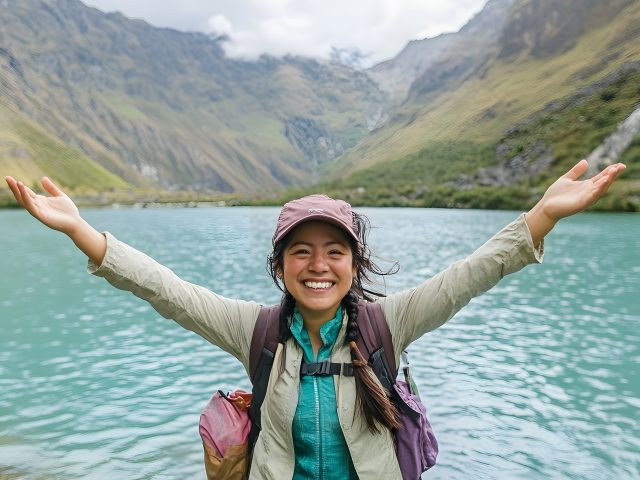 Killa VIP Zone
"Booking Inti Raymi with Andean Peru Treks was the highlight of our Peru trip. Being seated in the front row of the Killa VIP grandstand gave us an unobstructed view of the Sapa Inca and the sacred fire ceremony. All transfers were smooth and punctual!"
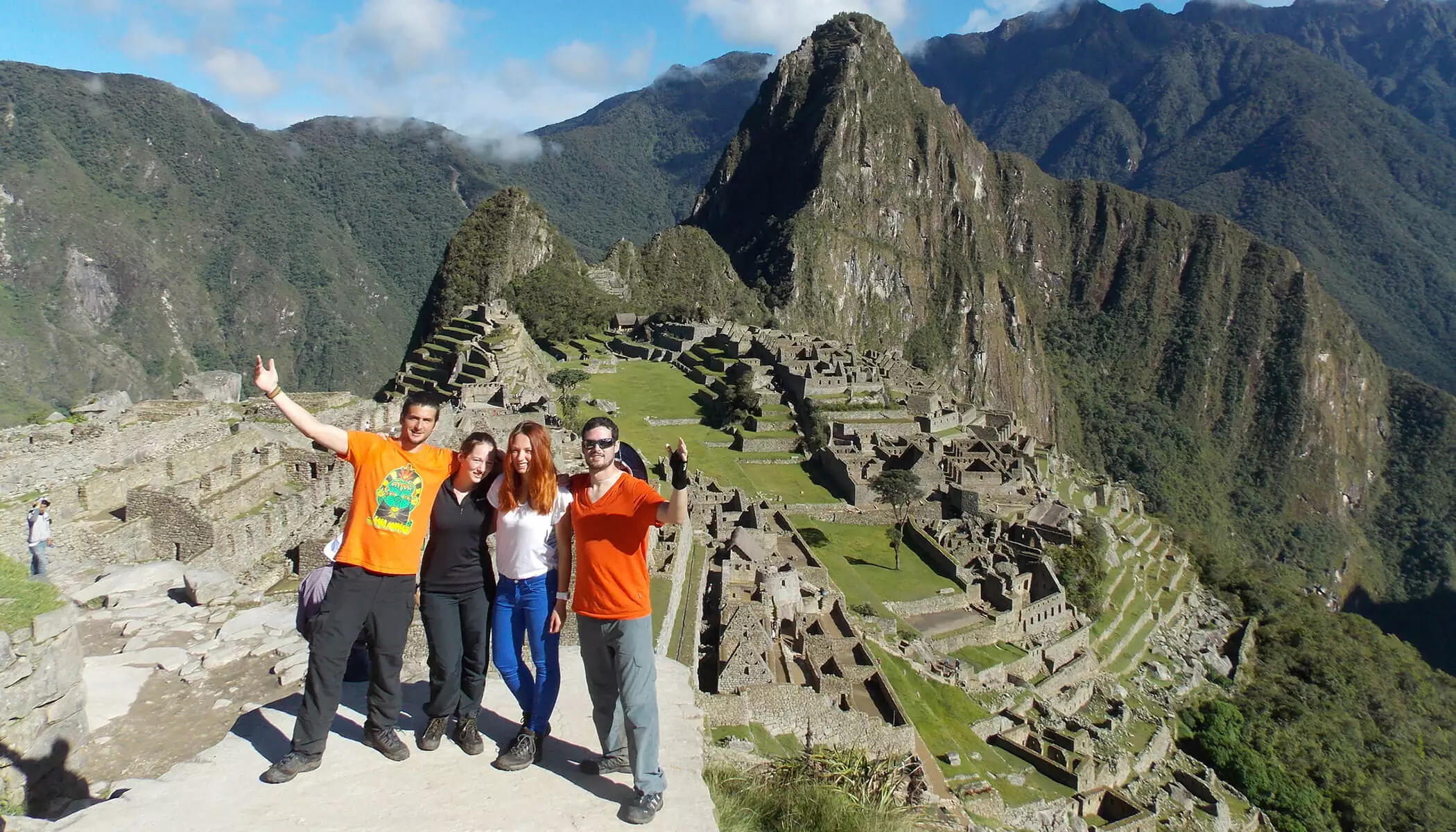 Family VIP Tour
"Our guide, Juan, translated every single Quechua prayer and chant in real-time through our audio headsets. Our teenagers were completely captivated from the opening at Qorikancha to the grand finale at Saqsaywaman. Absolutely world-class!"
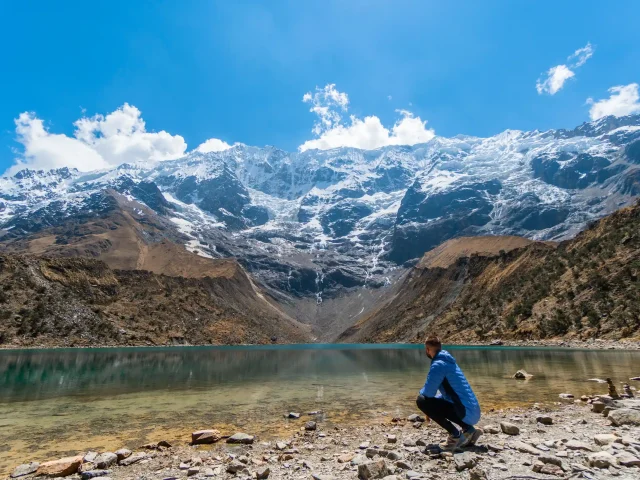 Grand Expedition
"We were apprehensive about altitude and festival crowd congestion, but the agency's private authorized shuttle bypassed all closed roads right to the perimeter. The gourmet box lunch and hot coca tea made a huge difference."
 Private Guide
"Very professional service from start to finish. Our seats were officially confirmed months before travel, so we had complete peace of mind. The views of the megaliths and the dancers' colorful traditional textiles were stunning."
 Machu Picchu Combo
"Vivir el Inti Raymi junto a cusqueños nativos te da una perspectiva inigualable. Sentir el orgullo de la cultura andina y luego visitar Machu Picchu en el tren panorámico fue la mejor experiencia de nuestras vidas."
 Inti Super VIP
"Everything went according to the exact schedule. Padded seats, shaded waiting lounge before entry, delicious Peruvian meal, and a historian guide who treated us like family. Truly exceptional value for a once-in-a-lifetime festival."
Clear answers about the 2027 date, tickets, seating, access and planning your day in Cusco.
| Topic | Status as of Late 2026 |
|---|---|
| Annual June 24 Celebration | Confirmed Calendar Tradition |
| Thursday, June 24, 2027 | Confirmed Date |
| Three Main Venues (Qorikancha, Plaza, Saqsaywaman) | Established Format |
| Official 2026 Ticket Prices | Verified Historical Reference |
| Seating Category Names (Illapa, Chaska, Killa, Inti Super) | Verified Format |
| 2027 Official Ticket Release Date | Awaiting EMUFEC Announcement |
| 2027 Official Pricing & Seating Chart | Awaiting Official Publication |
Machu Picchu reveals the architectural achievements of the Incas. The Sacred Valley explains how settlements and agricultural systems adapted to the high Andes. Inti Raymi adds living theatrical interpretation: ceremony, language, music, imperial representation, and collective cultural memory.
Watching the Sapa Inca appear against Saqsaywaman’s vast stone walls, surrounded by a large ceremonial cast, is a unique way to encounter Cusco’s historical imagination and modern cultural identity.
Inti Raymi is one of the most distinctive reasons to visit Cusco in June. Its setting, ceremonial traditions, historical theater, Quechua language, and expansive performance offer travelers a way to understand the cultural and spiritual dimensions of the Inca world beyond ordinary sightseeing.
The strongest 2027 plan balances cultural understanding, reliable event admission, physical comfort, clear agency terms, and sufficient time for acclimatization. A higher ticket price is not automatically the best experience: visibility, guidance, logistics, and personal priorities matter more.
June 24, 2027 offers the opportunity to experience the Festival of the Sun in Cusco, where Inca history and modern Andean cultural identity meet.
Share your travel details. Our Cusco team will check availability and prepare your personalized proposal.